September Monthly Market Review

Technology Leads as Inflation Pressures Persist
Inflation pressures prompted US and eurozone interest rate rises
Technology funds led sector returns as demand for AI remained strong
The Netherlands and Taiwan led their respective equity market groups
The Balanced portfolio benchmark, the UT Mixed Investment 20-60% Shares sector, returned -0.94% in sterling in September 2026, reflecting a challenging month for mixed investment portfolios.
Inflation and Interest Rates.
UK.
The Bank of England held Bank Rate at 3.75% in September, with a 6–3 vote. Annual CPI inflation reached 3.10% in August, its highest level since March, while core inflation held at 2.60%. Policymakers warned that prolonged disruption in the Middle East could require higher borrowing costs, as rising energy prices threatened to make inflation more persistent. [7,8]
U.S. Federal Reserve.
The Fed raised rates by 0.25 percentage points to a range of 3.75% to 4.00% in September, its first increase since 2023. September’s annual CPI inflation subsequently rose to 3.70%, from 3.40%, largely reflecting dearer petrol. Core inflation also increased to 2.60%, highlighting broader price pressures and renewing expectations of further monetary tightening. [9]
European Central Bank (ECB).
The ECB raised its deposit rate by 0.25 percentage points to 2.50% in September. Eurozone inflation accelerated to 3.80% that month, from 3.20%, driven by energy and food, while core inflation edged up to 2.50%. The ECB warned that inflation could remain above target for an extended period, but stressed that further decisions would depend on incoming data. [10,11]
Market performance.
Developed markets.
Top performer: MSCI Netherlands (+4.96%)
The Netherlands was the strongest developed market in September, supported by gains in semiconductor equipment maker ASML. Morningstar identified ASML as the main driver of Dutch outperformance, with banks also contributing. Japan (+3.57%) and Portugal (+3.25%) followed, while several larger European markets declined. [1]
Bottom performer: MSCI Denmark (−7.81%)
Denmark was the weakest developed market in September. Novo Nordisk came under pressure as investors questioned its pricing power, growth targets, and strategy ahead of patent expiries. Reuters reported a sharp fall in its shares following its investor presentation, providing context for the Danish market’s weakness. [2]

Emerging Markets.
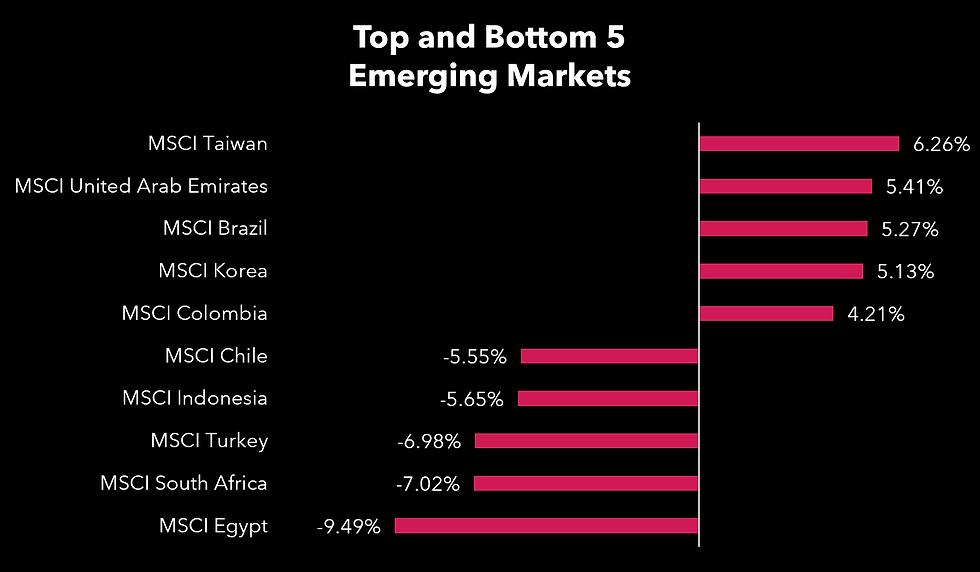
Taiwan (+6.26%) led emerging markets in September, alongside gains in the United Arab Emirates (+5.41%), Brazil (+5.27%), and Korea (+5.13%). Demand for AI chips remained supportive: Reuters reported record Taiwanese export orders released during the month, reinforcing optimism about the technology industry. [3]
Egypt (−9.49%) was the weakest emerging market, followed by South Africa (−7.02%) and Turkey (−6.98%). More broadly, tighter US monetary policy, rising Treasury yields, and a stronger dollar challenged emerging markets. Reuters reported substantial September capital outflows, illustrating the difficult backdrop despite gains in selected markets. [4]
Sector performance.
Top performer: UT Technology & Technology Innovation (+5.26%)
Technology funds led sector returns in September as renewed enthusiasm for AI supported chipmakers. Reuters reported a global technology rally on evidence of strong demand. Japan funds (+3.39%) also performed well, while gains elsewhere were more modest. [5]
Bottom performer: UT Commodity/Natural Resources (−5.35%)
Commodity and natural resource funds lagged as precious metals weakened, despite rising oil prices. Reuters reported gold and other precious metals heading for monthly losses amid interest rate pressures. Listed property (−4.38%) was another weak sector. [6]

Source: FE FundInfo, one-month total returns in sterling to 30 September 2026.
Summary.
September brought renewed inflation pressures and uneven market returns. The Federal Reserve and ECB raised interest rates, while the Bank of England held steady but warned that persistent energy pressures could require tighter policy. Subsequent September inflation releases showed further increases in the US and eurozone, reinforcing uncertainty over the path of borrowing costs. [7,9,10,11]
Technology remained a source of strength, supported by demand for AI and semiconductors. The Netherlands led developed markets, Taiwan topped emerging markets, and technology funds were the strongest sector. However, gains were far from universal: Denmark and Egypt were the weakest markets in their respective groups, while commodity and natural resource funds fell alongside listed property funds. [1,3,5,6] The contrast between technology gains and weakness elsewhere showed how differently markets responded to the same economic pressures. Emerging markets faced capital outflows despite pockets of resilience, leaving investors to balance opportunities in growing industries against inflation, tighter financial conditions, and geopolitical uncertainty. [4]
Sources.
The ‘Balanced portfolio benchmark’ is the UT Mixed Investment 20-60% Shares Sector.
Tradingeconomics.com, September 2026
[1] Morningstar, 8 October 2026. Germany Leads European Stock Market Declines in September
[2] Reuters, 21 September 2026. Wegovy maker Novo shares slump as management grilled on pricing, M&A
[3] Reuters, 22 September 2026. Taiwan August export orders hit record high value, strong AI demand leads
[4] Reuters, 7 October 2026. Hawkish Fed triggers emerging market outflows in September
[5] Reuters, 21 September 2026. Chipmakers fuel global stock gains as oil retreats
[6] Reuters, 30 September 2026. Gold falls despite cooler inflation data, monthly loss in sight
[7] Reuters, 17 September 2026. Investors cheer BoE move to pause gilt sales, driving bond rally
[8] Reuters, 16 September 2026. Sterling steady after UK inflation, eyes turn to BoE
[9] Reuters, 14 October 2026. US inflation heats up in September; Fed rate hike this month back on table
[10] ECB, 10 September 2026. Monetary policy decisions
[11] Reuters, 2 October 2026. Euro zone inflation surges more than expected, keeping pressure on ECB to hike rates https://www.istockphoto.com/